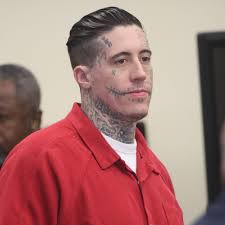
The courtroom was tense as Wade Wilson, one of Michigan’s most notorious death row inmates, stood before the judge to hear his fate. He was there to receive the formal sentence that would end his life — death by lethal injection. Families of his victims filled the benches behind him, waiting for justice, waiting for closure. But what happened next left everyone in the room shaken.
As the judge began to speak, her voice steady but heavy, Wilson suddenly raised his hand. “You don’t have to finish,” he said, his tone calm, almost amused. “I already know how this ends.” The judge tried to continue reading the sentence aloud, but Wilson interrupted her again — this time with a smile.
“I’ll be back,” he said softly. Then, with a small smirk, he added, “but not today.”
The words sent a wave of unease across the courtroom. A murmur rippled through the gallery. Some gasped, others stared in disbelief. The judge, visibly rattled, paused for a moment before regaining her composure. “Mr. Wilson,” she replied firmly, “you will not be coming back. Not to this courtroom. Not to this world.”
But Wilson just laughed.
Wade Wilson, 47, had already become infamous across the state — labeled by prosecutors as “the closest thing America has to a modern mob boss.” He had been convicted of multiple murders connected to organized crime, drug trafficking, and witness intimidation. His reign of fear stretched from Detroit to Chicago, leaving behind a trail of bodies and silence.
Yet even facing death, Wilson remained eerily calm. Throughout his trial, he smirked at witnesses, taunted prosecutors, and showed no sign of remorse. But his final outburst at sentencing turned what should have been the end of his story into another chilling chapter.
“Those words — ‘I’ll be back, but not today’ — they’ll haunt me forever,” said the mother of one of his victims. “He said it like he meant it.”
Prosecutors later revealed that Wilson had made similar statements in prison, telling guards he believed death wouldn’t stop him. “He’s obsessed with the idea of control,” said one officer. “He wants to be feared, even when he’s gone.”
Psychologists who analyzed Wilson’s behavior called it classic narcissistic psychopathy — the need to dominate every situation, even his own execution. “It’s not about life or death for men like him,” said forensic psychiatrist Dr. Leonard Ruiz. “It’s about power. His statement wasn’t fear. It was a final attempt to own the moment.”
In the days following the sentencing, Wilson’s words went viral. Clips of the hearing circulated online, sparking endless speculation. Some believed he was taunting the system. Others thought he was hinting at an appeal or even escape. But for those who knew his reputation, it sounded like something darker — a threat.
“He’s the kind of man who wants his name to live longer than his body,” said one former detective who worked Wilson’s case for years. “Even on death row, he wants to make sure people still whisper about him.”
As officers led him away in shackles, Wilson turned one last time toward the cameras. “Don’t wait too long,” he said with a grin. “You’ll see me again.”
The judge ordered the record sealed immediately after sentencing, saying, “This courtroom will not be used as a stage for evil.”
But the damage was done. Within hours, social media exploded with hashtags like #IllBeBack and #WadeWilsonLives, turning the convicted killer into an internet legend. True crime podcasts dissected his final words, debating whether they were arrogance, madness, or something supernatural.
For the families of the victims, though, there was nothing intriguing about it — only pain. “He still found a way to make it about himself,” said one father. “Even facing death, he couldn’t show a shred of humanity.”
Wade Wilson now sits on death row awaiting his execution date. Prison staff say he spends most of his time alone, writing letters no one sees and sketching faces that resemble his victims. When one guard asked if he was afraid of dying, Wilson reportedly smiled and said, “You can’t kill a ghost.”
And maybe that’s the point — in his mind, Wade Wilson never dies. His crimes, his arrogance, his smirk, and those final words were his last act of control.
“I’ll be back,” he said.
But as the judge reminded him that day, his return — if it ever comes — won’t be to freedom, or glory, or power. It will only be to the dark place he built for himself.
And when the day finally comes, when the last words are spoken and the lights go out, Wade Wilson will find that this time, there’s no coming back — not today, not ever.
When The Truth Hurts Louder Than The Lies And Family Can’t Take It
The case was supposed to be simple — a family disagreement about money, trust, and who was right or wrong. But as soon as he started talking, the entire courtroom shifted. His tone wasn’t angry. It was calm. Controlled. Too honest for comfort.
“I’m not here to be liked,” he said quietly. “I’m here to tell the truth.”
At first, there was silence. Then came the reaction — groans, murmurs, and boos echoing through the gallery. Someone even